

Raised By A River
Living Researcher: Ross Sullivan

Maybe you have noticed, maybe you have not, things are no longer what they used to be. In our own sort of ways, we’re all looking around wondering what’s gone wrong and where do we go from here, as we humans begin to wake up to our true nature.
“As human beings we don’t really know who we are. All we know is who we are when we’re plugged in to this ‘power-over’ paradigm. But who would we be in another paradigm?”
These words were powerfully spoken by Pat McCabe, Diné (Navajo) mother, grandmother and activist. These words ring true for humanity at large. And, if we scale down, they ring poignantly true for men in our modern Western culture. Our men who are the supposed protectors, providers, and lighthouses for our communities.
As men, we don’t really know who we are. Speaking from my own experience and observations, we only know ourselves within the context of this ‘power-over’ paradigm. A paradigm that necessitates us to be in constant competition for control and dominion over our external world. There is evidence that has been mounting for centuries that would lend one to believe that this orientation does not work for any being on our planet. The evidence comes in the form of mass extinctions, mass extractions, medical tyranny, religious tyranny, a society riddled with war, slavery, relative socioeconimic poverty, trauma, stress, disease, distortion, I could go on, but all of it abuse — violence needlessly perpetrated on the ecology of our planet. When we listen deeply we know that humans and all other life forms on this planet are intricately woven within this same web of ecology. When we zoom out, even the slightest bit, we see that all of this violence has largely come at the hands of men.
At the root of this violence is our not knowing who we are. In other words, we are not in right relationship with ourselves. But, how did we arrive here to this place of deep disconnection from ourselves, as a collective of men?
I’d like to pose a question to answer the previous question. Could it be that the root of our lost gnosis is that we are not in right relationship with our mothers? The very waters, the very Earth, from which we are born.
In one way or another, for much of my adult life, I have been consciously or unconsciously, reconciling my relationship with my own mother. With deeper introspection, I can understand that this is to say, reconciling my relationship with my own inner feminine essence, as a part of the wholeness that makes me who I am.
Privilege and a bit of divine guidance has afforded me several opportunities to sit in ceremony with ayahuasca, an ancient, sacred and powerful medicine of the indigenous peoples of the Amazon. The brew that is ayahuasca, composed of the vine ayawaska (a phrase from the Quechua language meaning “vine of the soul”— most commonly the liana Banisteriopsis caapi) and a DMT- containing admixture plant usually called Chakruna (Quechuan for “mixture”— most commonly leaves of Psychotria viridis or Diplopterys cabrerana), is used for both physical and spiritual healing. I have used this ancient technology as a part of my process of deeper introspection.
Going on the basis that all living beings, plants included, are sentient, which modern science shows isn’t that far of a leap, then we can understand that plants too have intelligence, even soul. With proper respect and permission we can communicate with them for our healing.
The trance-like state of consciousness brought on by the brew, for me at least, opens up a pathway for this direct communication with her, grandmother ayahuasca.
All of this is to share with you that at the beginning of 2020 I sat in ceremony with deep intention for spiritual healing. In one particular ceremony I asked ayahuasca about my mother. She answered succinctly, “You hate your mother.”
Well, that was a shocking response. And I was immediately in denial. I was so afraid of the answer she gave me that I immediately left the question and moved on to something else. I was afraid to follow the thread.
But, as these things tend to go, I found myself back in the United States a few weeks later, returning home to my parents house in Harrisburg, Pennsylvania inevitably bunking up with them for the impending lock downs. I was going to have to live out the thread that I was so afraid to follow. What did follow, however, was nothing short of a revelation. As Joseph Campbell famously says, “The cave you fear to enter holds the treasure you seek.”
Growing up I interpreted my mother to be often emotionally unpredictable, volatile, and full of worry and concern. As a boy, with a strong psychological drive to experience freedom, this felt overbearing and deeply uncomfortable. I rejected it. I rejected her, sometimes subtly and other times not so subtly. Throughout much of my life we challenged each other. She, speaking truths or voicing concerns that I was unwilling to hear. I, constantly questioning, judging and blaming her. I had learned to keep my distance emotionally too, never allowing much space for joy in our relationship. But, it’s a funny revelation, you know. After a few months of living with my mother as an adult, fresh out of the jungle, I discovered that what I actually ‘hated’, or rather what I was unable to love, were the parts of myself that I had rejected, stuffed into the darker recesses of my psyche and projected onto my own mother.
You see, modern mothering culture in the West doesn’t leave much room for the darker side of mothering. In fact, our culture generally tends to avoid the uncomfortable and push it aside into the shadows.
Hidden from sight, but there nonetheless. I am no expert in the field, to say the least, but I’m sure those of you who are mothers know exactly what I mean. Our culture’s myths and stories that inform our perceptions, really only give us an idealized archetype of the ‘Good Mother’. She embodies unconditional love, compassion and nurturing — leaving no space for emotions like impatience and anger, even pure rath. The problem here is that this one-sided story teaches both mother and son that anything less than a ‘Good Mother’ is deviant or unnatural. What happens next is exile. We, men especially, learn to reject our mothers. Even if it is subtle, rejecting our mothers, our first models of the feminine, is to then reject the feminine wholly. This has tragic consequences that weave the fabric of the ‘power-over’ paradigm that’s destroying the planet.
In the ancient Andean tradition of the Quechua peoples, the Elders teach that we each have four parents. Our personal Mother and Father, and a Nature Mother and Father. Our Nature Father is the largest land mass nearest to our birthplace. It could be a hill, a mountain, or a peninsula. Our Nature Mother is the largest body of water. Maybe a creek, a river, or the sea. While at home in Harrisburg, Pennsylvania I began to feel an unexplainable longing to connect more deeply with the land where I was born. And truly feeling estranged from my own parents at the time, I began to forge relationships with my nature parents. Especially my nature mother, Susquehanna River. I talked to her daily, making offerings of sage, tobacco, cedar, and grief.
I began to ask her, “How can I serve you?” … “You have raised me, and I haven’t even acknowledged you, what can I do to give back? I am listening now.” One day she answered loud and clear. “Tell my story. My story is ready to be heard.”
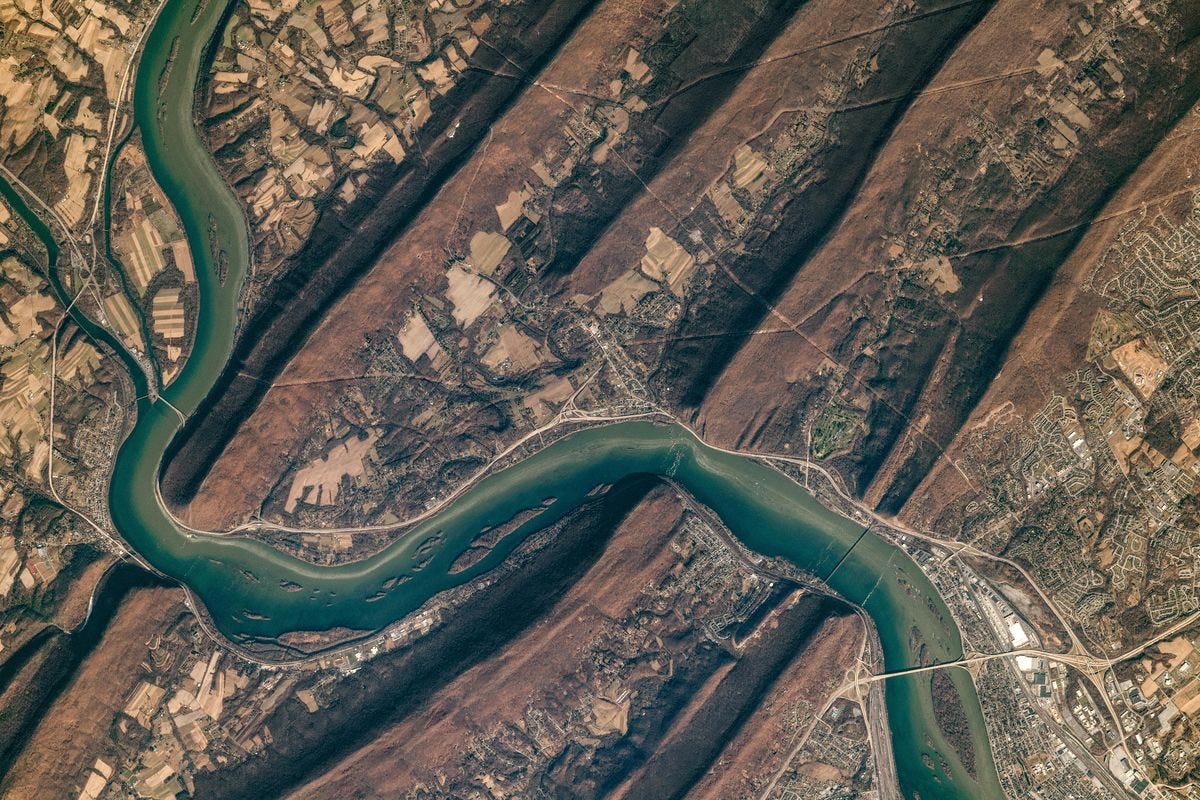
The Susquehanna River is one of the oldest, most ancient rivers on the planet. Forming somewhere between 300 and 500 million years ago. It predates the supercontinent Pangea. Jamestown, the first settlement in the “New World” was born beside her waters. Along with the historical facts, the Chesapeake Bay Foundation says that pollution, acidity, or physically altered habitat and hydrology prevent more than 7,100 miles of the streams in the Susquehanna River Basin from providing a livable habitat for aquatic communities or being safe for human use. The significance here must not be understated. But this is where, I suggest, a paradigm shift happens. This is all history, ‘his-story’.
Aldous Huxley said, “That men do not learn very much from the lessons of history, is the most important of all the lessons that history has to teach.”‘His-story’ has already been written for us to see. What is it that we are missing here? Maybe we are missing ‘her-story’.
In this story, I suspect that the lessons can be found in the silence. They can be found in what hasn’t been written. Maybe, the greatest lessons for men to learn lie in what he has rejected, omitted, forgotten and suppressed. The voices of our mothers. Because, with these lessons we can learn and vision what is possible for a future which serves us all.
As I began building a more intimate relationship with my Nature Mother, something dawned on me. Why was I so willing to honor the river in this way, but not my own personal mother?
That single question changed everything. I realized that this is ‘her’ story. This is the story that is now ready to be heard. Not history, but ‘her-story’. The story of right relationship. The story of our mothers.
Our mothers, with all that they are — their nourishing goodness, their indulgent emotionality, and their dark depths — lead us back home to our true nature, calling home the exiled parts of ourselves into wholeness and belonging. Our mothers lead us back to Life. Back to the very fabric of creation — that same nourishing goodness, indulgent emotionality, and dark depths.
Our mothers lead us back to the life giving divine force that births each moment. If we have exiled our mothers, we have exiled Life. When that happens we orient to the ‘power-over’ paradigm — to take without consent, to extract without reciprocity, to destroy ourselves, each other, Mother Earth, and finally Life itself.
What does it actually mean to be in right relationship? I won’t attempt to provide an answer here, though I’m sure responsibility and reciprocity have something to do with it. But the truth is I’m still learning. I have more questions than answers. And, when it comes to the paradigm shifting magnitude of being in right relationship with our mothers, I must choose to hear it straight from their mouths. I choose to hear it from those who have been silenced and belittled.
What is the deeper wisdom of our mothers? How do we, as men, come into right relationship with our mothers? With Mother Earth? With the Great Mother of all things, the very fabric of Life?
These are big questions, but I ask them in hope of a way forward. You see, I was raised by a River, but I did not listen. I did not take the time to acknowledge her plight. I barely even noticed her there.
Men, we have all been raised by a River, in one way or another. Can we listen to her? Can we take time to acknowledge her plight? Can we notice her there, even amplify her voice? Our present and our future depend on it.
Ross Sullivan is an explorer, mystic, futurist and systems strategist. Stewarding Sustainable Futures Institute. He first submitted Raised by A River to Soul Seed Gathering in 2021.
Join us for our next cohort of our Living Research Program starting January 15th - email soulseedgathering@gmail.com
To apply for our scholarship (submit by Dec 15th) read more here: